Biography
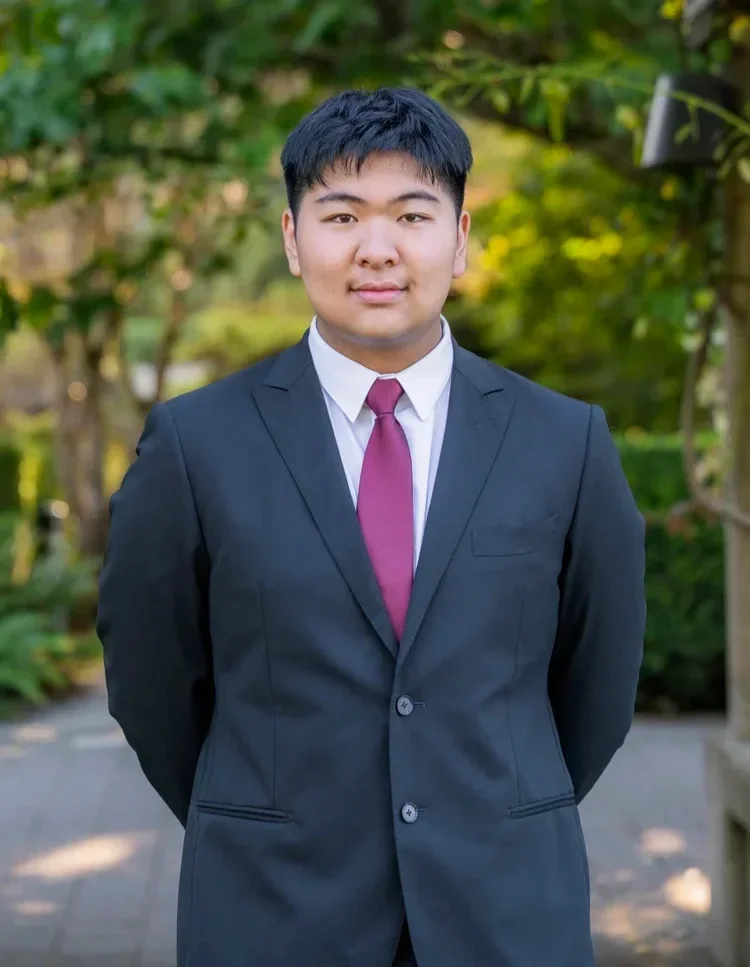
Richard Li is a student, classical vocalist, writer, and youth leader based in Vancouver, Canada. A student at St. George’s School, his interests span music, philosophy, public affairs, and community service. Although these pursuits have taken him from concert halls and hospital performances to Model United Nations conferences and writing workshops, Richard sees them as connected by a common curiosity: how people listen to one another, how ideas shape the way we understand the world, and how individual interests can become meaningful forms of contribution.
Music has been one of the most enduring threads in Richard’s life. As a bass-baritone, he has pursued classical voice through years of study and performance, developing a repertoire ranging from German Lied and English art song to opera. His repertoire has included Ralph Vaughan Williams’s The Vagabond and Silent Noon, Robert Schumann’s In der Fremde, Handel’s Ombra mai fu, Mozart’s Der Vogelfänger, and Aaron Copland’s The Little Horses. Alongside voice, Richard has studied piano through Royal Conservatory Level 8 and has performed on trombone and tuba.
His musical journey has brought him into both competitive and professional artistic environments. Richard received the Judges’ Distinction Award and First Place at the American Protégé International Vocal Competition, and was a British Columbia Second Place winner and National Finalist in Voice at the Canadian Music Competition. He has participated in the Vancouver Opera Mentorship / Opera Experience program, gaining exposure to the collaborative work behind professional opera, and his vocal development has included work with Steven Chen Wang, Hong Luo, Robyn Driedger-Klassen, and Penelope Bitzas through the Boston University Tanglewood Institute Young Artists Vocal Program.
Yet as Richard’s relationship with music deepened, so did his belief that performance could have a life beyond the concert hall. Music did not have to exist only for an audience seated in rows; it could also bring people together, offer moments of connection, and serve communities.
That belief became central to his work with Firefly Youth Network, a youth-led nonprofit initiative he helped build. Since its founding in 2021, Firefly has grown into a network of more than 100 youth members who use music and youth engagement to support hospitals and community organizations. Richard has helped organize charity concerts, fundraising initiatives, hospital performances, and community programs, working alongside young musicians and volunteers to turn artistic interests into collective service.
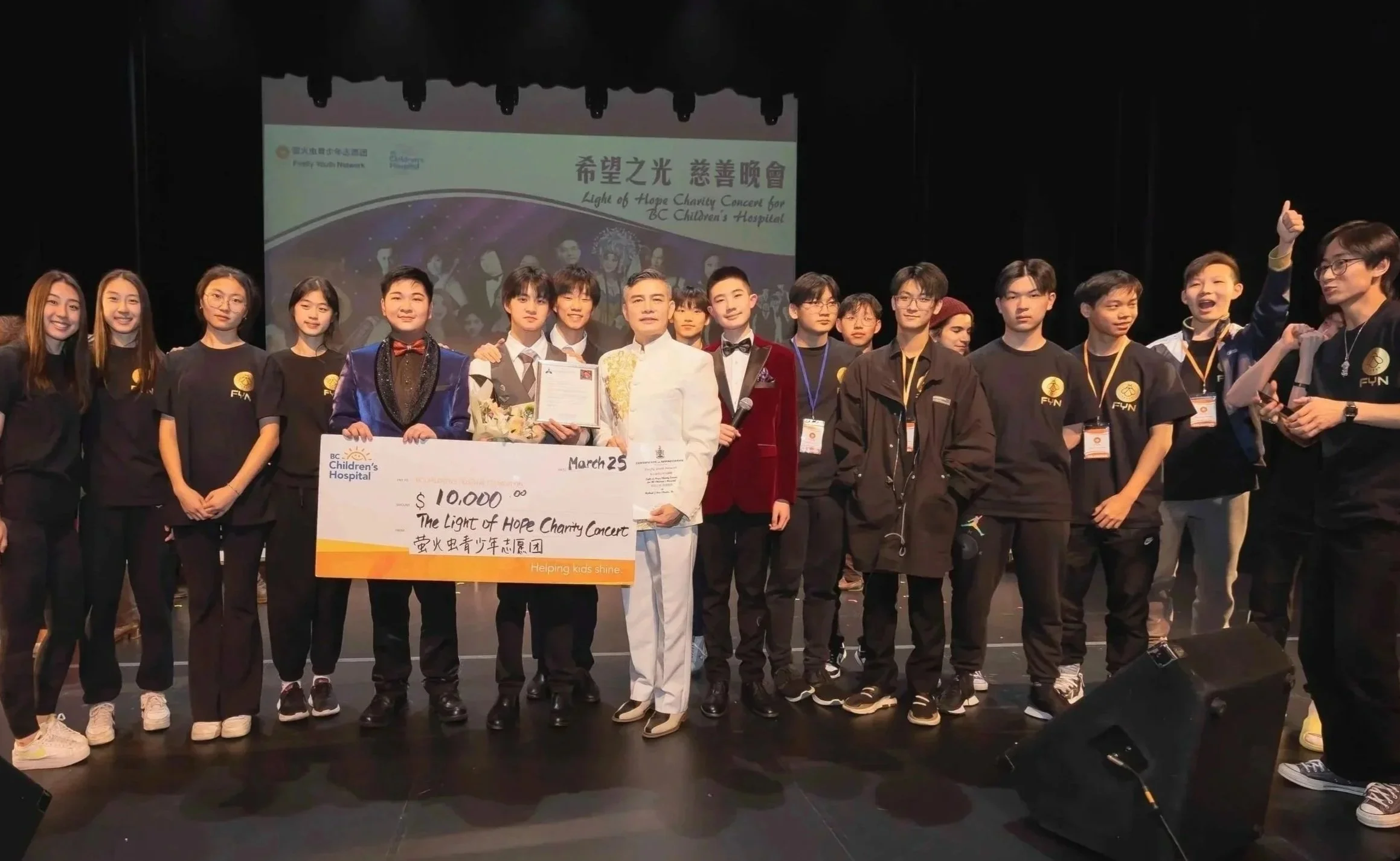
Through Firefly’s Light of Hope concert series and other initiatives, its young volunteers have helped generate more than CAD $70,000 in charitable support for hospitals and community causes. Firefly’s work has included support for Richmond Hospital and BC Children’s Hospital, as well as performances that bring young musicians into spaces where music can offer something different from the traditional concert experience. In August 2026, Richard led and organized fellow Firefly musicians in performing at BC Children’s Hospital for children, families, and hospital staff. The organization’s work has also been featured by media including OMNI Television and Phoenix TV.
If music taught Richard to listen closely to an individual voice, Model United Nations challenged him to listen across differences. What began as an interest in global affairs gradually became an education in diplomacy, negotiation, public speaking, and—perhaps most importantly—the difficulty of building consensus among people who do not begin from the same assumptions.
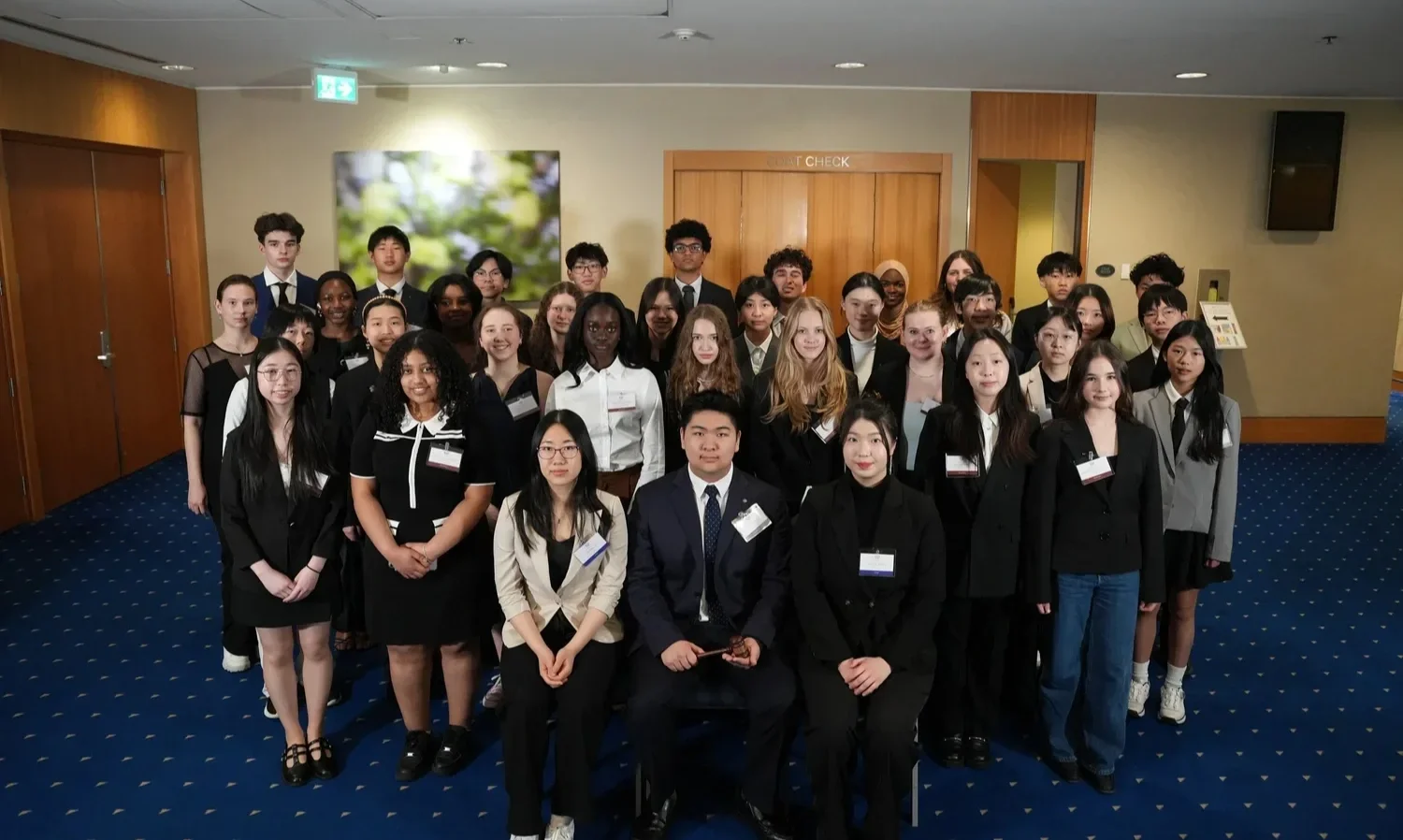
Over several years of Model United Nations, Richard has progressed from participant and delegate to staff member, conference leader, and organizer. His involvement has included leadership roles at conferences such as VMUN and CAHSMUN, and he was selected to serve as Secretary-General of CASMUN for the 2026–27 school year. In that role, he helps lead the planning of a major student-run conference, working with fellow students not simply to stage an event, but to create a setting in which younger delegates can learn to speak thoughtfully, disagree constructively, and engage with issues larger than themselves.
Richard’s interest in public affairs also extends to environmental and community initiatives. Through leadership roles with LCOY Canada, Human & Nature Youth Club, and the Richmond Lahoo Leo Club, he has explored different forms of youth participation—from climate awareness and sustainability to local volunteer service.
At St. George’s School, Richard served for four consecutive years as an elected Community Engagement Representative in Student Government. In 2025, after several years without a TEDx event at the school, he took the initiative to revive the program, applying for a new TEDx license and leading the event from its earliest planning stages through its realization. Working with students, faculty, and speakers, he helped rebuild a platform for ideas and conversation within the school community. He has also contributed to school life through OPUS Art Journalism and Publication, Yearbook, and other student initiatives.
That same curiosity increasingly found its way onto the page.
Writing has given Richard a different kind of space: one in which questions do not always need immediate answers. His interests increasingly center on philosophy, ethics, politics, literature, and the ways these fields intersect. He has received a Scholastic Gold Key, while pursuing more intensive study through experiences including the Stanford Summer Humanities Institute and the Kenyon Review Young Writers Workshop. Through OPUS and his own writing, he has also explored the relationship between art, culture, ideas, and public expression.
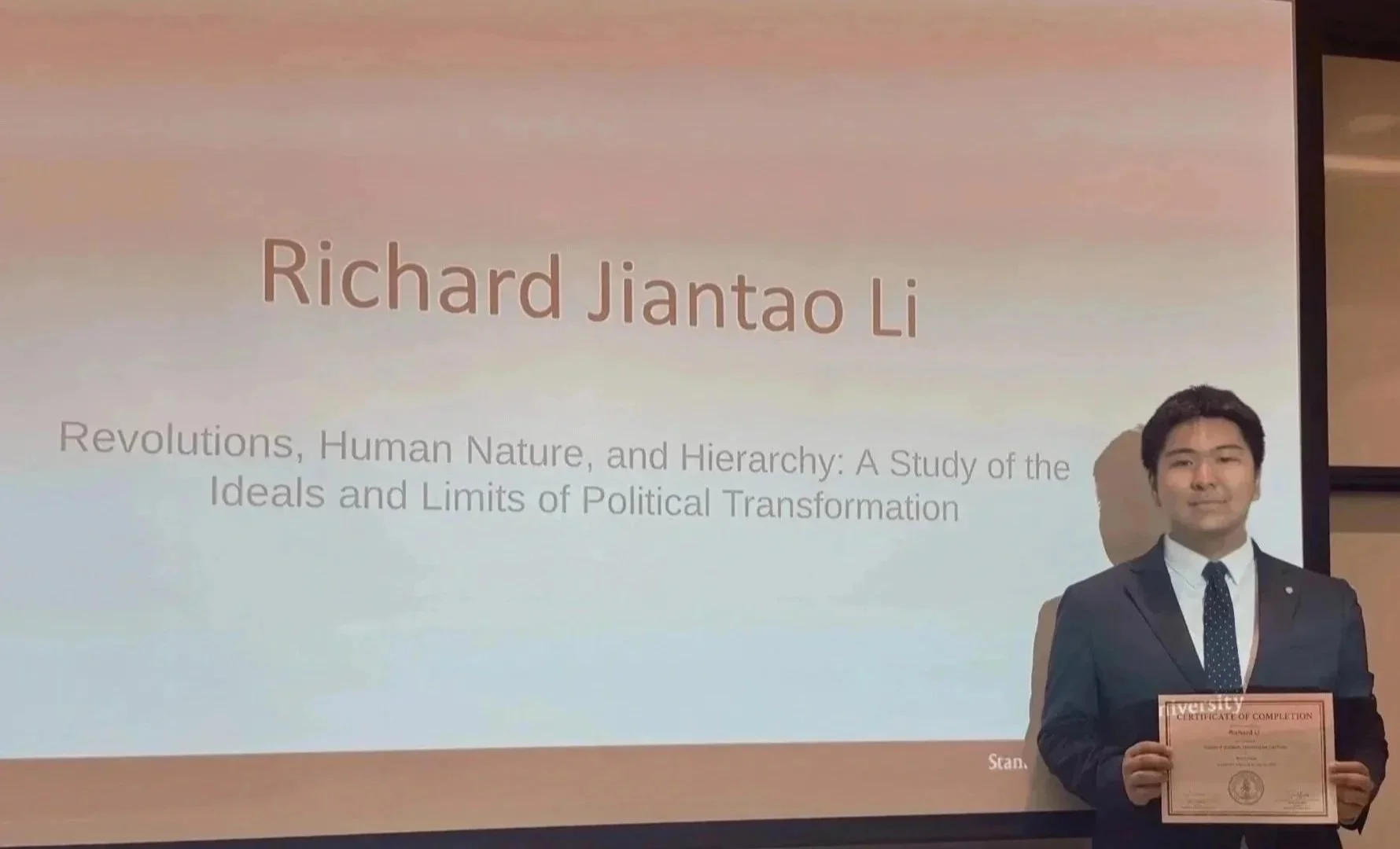
Across these experiences, Richard has become especially interested in questions that resist simple resolution: What responsibilities do individuals have toward their communities? How should people with fundamentally different perspectives live together? What can art reveal about another person’s experience that argument cannot? And what does it mean not merely to hold an idea, but to examine why we believe it?
These questions connect areas of Richard’s life that can appear very different on paper. The attentiveness required to interpret a song is not entirely separate from the attentiveness required to understand an opposing delegate. The curiosity behind an essay is related to the curiosity that makes genuine dialogue possible. And the experience of bringing music into a hospital has challenged him to think about what artistic expression can mean when its purpose is no longer applause.
Richard also values parts of life that have no need to become a résumé line. He enjoys reading, exploring new ideas, spending time outdoors, and competitive gaming. In League of Legends, he reached the Masters tier, placing him among approximately the top 0.5% of players in North America.
Richard does not yet know exactly where all of these interests will lead—and he is comfortable with that. What matters more to him is continuing to ask difficult questions, listening closely to people and perspectives different from his own, and finding ways to turn the things he cares about into something useful beyond himself.
Music taught him to listen. Writing taught him to question. Leadership taught him to take responsibility. Service taught him why those things matter.